SHIPIBO-KONIBO CULTURE
A Living Culture.
A Living Lineage.
For generations, Shipibo-Konibo families have carried knowledge through land, river, plants, patterns, song, ceremony and service.
This is not a culture frozen in the past.
It is a living relationship—adapted, protected and passed forward.
Enter the culture below ↓
THE PEOPLE OF THE UCAYALI
More Than Two Thousand Years of Relationship
For more than two thousand years, the Shipibo and Konibo peoples have lived within the Ucayali region of the Amazon River basin.
Previously distinct peoples, they became increasingly connected through intermarriage, shared communities and cultural relationship. Today they are commonly known together as the Shipibo-Konibo.
They have often been described as caretakers of the jungle because their lives developed through sustained relationship with the rivers, forests, animals and extraordinary diversity of Amazonian plants.
Today, tens of thousands of Shipibo-Konibo people live in and around Pucallpa, Yarinacocha, communities along the Ucayali River and more remote settlements throughout the wider region.
A LIVING CULTURE
One Foot in Ancestral Knowledge. One Foot in the Present.
The Shipibo-Konibo do not belong only to history.
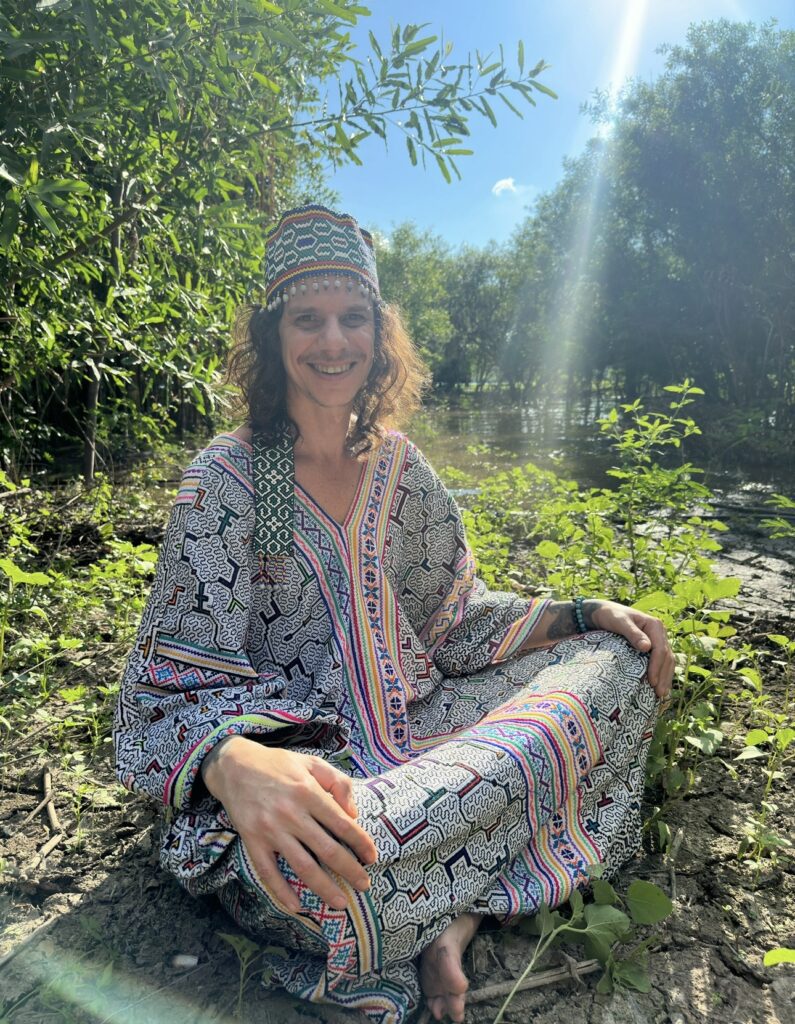
They live within the realities of the twenty-first century while continuing to carry language, family structures, artistic traditions, plant knowledge, ceremony and healing practices passed through generations.
Some communities live close to cities and participate deeply in modern economic life. Others remain in more remote river communities. There is no single Shipibo-Konibo experience.
What connects the culture is not sameness.
It is an ongoing relationship with family, territory, memory and the knowledge entrusted to each generation.
“Culture Is Not Preserved by Being Frozen.
It Is Preserved by Being Lived.”
FAMILY & COMMUNITY
Life Is Built Through Shared Responsibility
Family and community sit at the center of Shipibo-Konibo life.
Traditionally, survival depended upon shared labor. Men and women both participated in agriculture, fishing and gathering food. Men commonly took responsibility for physically demanding work such as felling trees, building houses, making canoes and carving wooden objects. Women commonly tended fields, prepared meals, cared for children, managed the household and created ceramics, textiles and beadwork.
These roles have never remained completely fixed. Modern employment, migration, education and city life have changed how many families organize themselves.
The deeper pattern remains: knowledge and survival move through relationship.
Family is not separate from culture. Family is one of the places culture continues.
HISTORY & MODERN PRESSURES
Survival Has Required Adaptation
For centuries, many Shipibo-Konibo communities lived with limited contact from outside society.
The nineteenth-century rubber boom brought violence, extraction and growing pressure from the wider economy. Shipibo people were drawn into wage labor involving agriculture and timber, often under mestizo bosses and patrons. Contact also expanded through physicians, nurses, missionaries and representatives of the Peruvian state.
Those pressures did not end with the rubber boom.
Today, Shipibo-Konibo communities continue meeting the effects of colonialism, logging, oil speculation, narco-trafficking, missionary influence, economic inequality and the loss or contamination of ancestral territory.
Culture has survived because people continued carrying it—even when the conditions around them made that difficult.
LAND RIVER & FOREST
The Environment Is Part of the Knowledge
Shipibo-Konibo culture emerged through direct relationship with the Amazon.
The river provides food, movement and connection between communities. The forest provides materials, medicine, shelter and instruction. Agriculture, fishing and gathering are not merely economic activities. They are ways of reading seasons, territory and the living systems that sustain the community.
This is one reason plant knowledge cannot be separated completely from place.
The medicine does not begin with a bottle or a ceremony.
It begins with a culture that learned by living inside one of the most biodiverse environments on Earth.
KENÉ & VISIONARY ART
When Worldview Becomes Pattern
Shipibo-Konibo art is recognized through the intricate geometric designs often called kené.
These patterns appear across textiles, pottery, baskets, beadwork, painted objects and the body. They are more than decoration.
Within traditional understanding, the designs express relationship, balance and the interconnected nature of existence. They can be understood as visual maps of an ordered field connecting people, plants, animals, territory and the unseen dimensions of life.
What Western perception may separate into art, medicine, music and spirituality is often held inside one connected system.
The pattern makes that relationship visible.
ICAROS
When Pattern Becomes Song
Within Shipibo-Konibo tradition, Icaros are healing songs used in ceremony and plant work.
The visual patterns of kené and the musical patterns of Icaros are often understood as two expressions of the same underlying order. A practitioner may describe seeing a pattern and recognizing its song—or hearing an Icaro and understanding its corresponding design.
An Icaro is not simply a melody memorized for performance.
Within the tradition MERAYA has learned from, it may emerge through dieta, dream, ceremony, silence and sustained relationship with a plant teacher.
The song becomes an expression of something the apprentice has lived.
“The Pattern Can Be Seen.
The Relationship Can Be Sung.”
CURANDERISMO
Healing Through Relationship and Balance
The Shipibo-Konibo carry a long tradition of Curanderismo—healing practices developed through plants, prayer, song, ceremony, observation and apprenticeship.
Within this traditional framework, physical illness, emotional suffering, destructive thought patterns and spiritual disturbance may be understood as different expressions of imbalance.
The Curandero or Curandera works to recognize what is out of relationship and to support a movement toward greater coherence.
This may involve medicinal plants, cleansing, Icaros, Mapacho, prayer, touch, ceremony or guidance.
These are traditional and experiential understandings. They should not be confused with guaranteed medical outcomes or used to replace appropriate medical care.
PLANT DIETA
The Apprenticeship Behind the Medicine
Traditional healers are not formed through ceremony alone.
Their path may involve years or decades of plant dieta: receiving a plant preparation, entering periods of isolation, simplifying food, pausing sexual activity and reducing outside stimulation so that attention can remain with the relationship.
Each plant is understood to carry particular qualities, teachings and healing applications.
The apprentice does not simply collect information about those plants. They are asked to develop the discipline, sensitivity and embodiment required to carry the relationship responsibly.
The restrictions create the conditions.
The relationship becomes the apprenticeship.
LINEAGE & TRANSMISSION
Knowledge Moves Through People
Traditional knowledge is not only contained inside explanations.
It moves through relationship—between parents and children, grandparents and grandchildren, maestros and apprentices, plants and people, families and communities.
A father may teach a son. A grandmother may guide a granddaughter. A practitioner may help an apprentice begin a relationship with a plant they have already dieted for many years.
Transmission does not remove the apprentice’s responsibility to learn.
It gives the relationship a supported beginning and places the student inside a chain of experience, correction and accountability.
THE CEREMONIAL CONTAINER
The Maestro and Maestra Carry More Than Technique
Within a Shipibo-Konibo Ayahuasca ceremony, the presence of experienced Curanderos helps shape the container.
After the medicine is received, the room may remain quiet while its effects begin. The maestro or maestra then opens the work through prayer and Icaros, singing to the group and often to individuals.
A practitioner may sit directly before a participant, sing an Icaro and complete the work with Mapacho smoke or Agua Florida. When several practitioners work together, their songs may move in relationship across the room.
The purpose is not performance.
The practitioner is drawing upon relationships, remedies and patterns developed through apprenticeship.
BALANCE PATTERN & ARCANA
Healing Is Understood as the Restoration of Order
Within Shipibo-Konibo traditional understanding, health is connected with balance between mind, body, emotion, spirit, community and environment.
Fear, anger, grief, harmful relationships or outside influences may be understood as disturbances within that wider field.
Through Icaros and other remedies, the practitioner works to support a different pattern—one associated with greater harmony, protection and coherence.
An Arcana is understood traditionally as a form of energetic protection and containment.
Within dieta, the opening will include an Arcana, and the closing will include an Arcana to seal and protect what has been developed before reintegration begins.
This is a traditional framework, not an established scientific mechanism.
A CULTURE NOT A MUSEUM
Tradition Changes Without Becoming Meaningless
Living cultures adapt.
Shipibo-Konibo people use phones, attend universities, travel, work in cities, create contemporary art, sell textiles internationally and participate in the modern economy.
None of this automatically makes them less indigenous.
The deeper question is whether the relationships, language, responsibilities and knowledge that give the culture coherence can continue through change.
Preservation does not mean asking people to remain trapped in the past for the comfort of outsiders.
It means supporting their right to determine what continues, what adapts and what remains protected.
MERAYA & THE FAMILY
Relationship Before Representation
MERAYA is carried through relationships with elders, maestros, maestras, families, collaborators and apprentices.
We do not present Shipibo-Konibo culture as something we own.
We are students within relationships that have changed our lives and given us responsibilities.
Those relationships ask for gratitude, honesty, reciprocity and care in the way knowledge is shared.
They also require us to distinguish what we have learned directly, what belongs to a particular family or lineage, what can be shared publicly and what should remain protected.
“Tradition Is Not Something We Collect.
It Is Something We Enter With Humility, Relationship and Responsibility.”
DIFFERENT FORMS OF KNOWING
Tradition Experience Psychology and Science
Shipibo-Konibo knowledge has developed through generations of direct observation, apprenticeship and cultural interpretation.
Science asks different questions. Psychology offers different language. Personal experience provides another form of information.
These perspectives can inform one another without being collapsed into the same claim.
When something belongs to traditional understanding, we name it as tradition. When it comes from direct observation, we name it as observation. When research supports a claim, we can say so.
And when we do not know, we leave room for not knowing.
CULTURAL RESPECT
What This Culture Asks of Visitors
Respect involves more than admiration.
It means arriving without treating indigenous knowledge as a product to collect. It means listening before claiming expertise. It means recognizing that an Icaro, a pattern or a plant relationship carries context that cannot be copied simply by reproducing its outer form.
Respect also means appropriate payment, credit, consent, reciprocity and care for the people whose culture makes the experience possible.
The goal is not to imitate the Shipibo-Konibo.
It is to enter relationship honestly and allow that relationship to make us more responsible.
THE CULTURE CONTINUES
Knowledge Survives Through Service
A tradition remains alive when it continues helping people meet real life.
Shipibo-Konibo healing practices have supported communities through illness, grief, fear, conflict, loss and change. People from outside the culture now travel great distances seeking that knowledge.
This creates possibility and responsibility.
The work must support the dignity of the culture carrying it. Healing cannot be separated from the people, families and territories that protected the knowledge long enough for others to encounter it.
The future of the tradition will be shaped by how those relationships are honored now.
COMMON QUESTIONS
Questions About Shipibo-Konibo Culture
Culture is larger than ceremony. These questions offer a grounded introduction to the people, traditions and relationships behind the work.
The Shipibo and Konibo were historically distinct Amazonian peoples who became increasingly connected through intermarriage, shared communities and cultural relationship.
Today they are commonly known together as the Shipibo-Konibo.
Many Shipibo-Konibo people live in and around Pucallpa, Yarinacocha and communities along the Ucayali River. Others live in more remote settlements or have moved to cities elsewhere in Peru and beyond.
No.
Some people live in remote river communities. Others live in cities, attend universities, work internationally or move between different worlds.
A living culture contains diversity.
Kené refers to the intricate geometric designs associated with Shipibo-Konibo art and worldview.
The patterns appear across textiles, pottery, beadwork, painted objects and the body. Within traditional understanding, they express balance, relationship and the interconnected nature of existence.
Icaros are healing songs used in Amazonian ceremony and plant work.
Within Shipibo-Konibo tradition, an Icaro may emerge through dieta and sustained relationship with a plant. It is more than ceremonial music or a song learned through imitation.
No.
Healing knowledge belongs to particular people, families and lineages. Becoming a Curandero or Curandera may require many years of apprenticeship, dieta, correction and service.
Plant dieta is one of the central apprenticeship practices through which a healer may develop relationship with particular plants.
It combines ingestion, agreed restrictions, reduced stimulation, guidance, ceremony and time.
Within the traditional framework MERAYA has learned from, an Arcana is a form of energetic protection and containment established by a practitioner.
It is used in the opening and closing of dieta and in other healing contexts. This is a traditional understanding, not an established scientific mechanism.
Shipibo-Konibo communities have faced pressures connected with the rubber economy, missionary activity, logging, oil speculation, narco-trafficking, economic inequality and the loss of territory.
The culture has survived through adaptation, family transmission and continued responsibility to community.
Begin with humility.
Listen before claiming expertise. Respect consent, boundaries, payment, attribution and the cultural context behind songs, designs and plant practices.
The purpose is not to collect indigenous identity. It is to enter relationship responsibly.
Still Have Questions About Whether This Path Is Right for You?
EXPLORE THE PATH
Continue Your Understanding
Shipibo-Konibo culture sits inside a wider ecosystem of plant relationship, apprenticeship, ceremony, safety and human development.
THE DEEPER JOURNEY
Enter the Jungle. Enter the Relationship.
MERAYA’s 14-Day Jungle Initiation brings plant dieta, Shipibo-Konibo ceremony, psychological understanding and practical integration into one held developmental journey.
The purpose is not cultural tourism.
It is to enter relationship with greater preparation, humility and responsibility.
DISCOVERY CALL
For in-person Jungle Initiations, enrollment is available by Discovery Call only.
NOT SURE WHICH PATH IS RIGHT FOR YOU?
You may be exploring personal healing, deeper shamanic development, online training, or an immersive journey into the Amazon.
You do not need to figure it all out alone.
Book a personal discovery call with MERAYA to ask your questions, explore the different ways to work with us, and understand which pathway may best support where you are now.
No pressure. Just a conversation, clarity, and a clear next step.
JOIN THE MERAYA COMMUNITY
JOIN THE MERAYA COMMUNITY
Stay connected to the teachings, trainings and conversations emerging from Meraya.
For now, join the community and receive our free Ayahuasca Masterclass video training, together with ongoing teachings on plant medicine, shamanic development, integration and walking the path with greater clarity.
Join a growing community of people committed to healing, development and living what they learn.
Walk The Shamanic Path With Clarity
GROW DEEP. SERVE WELL.